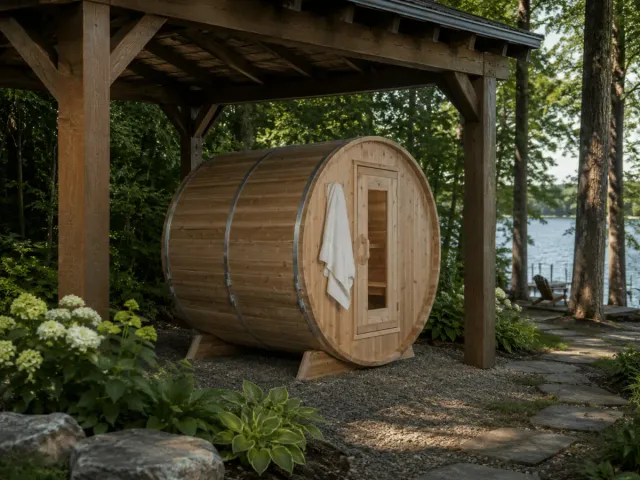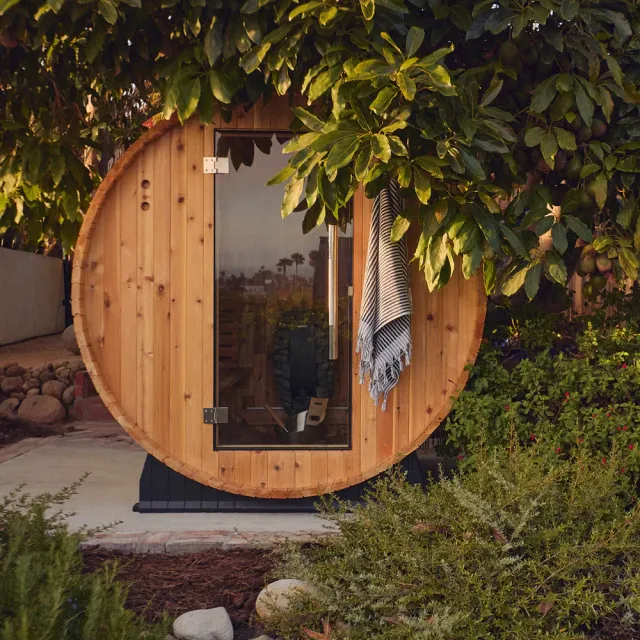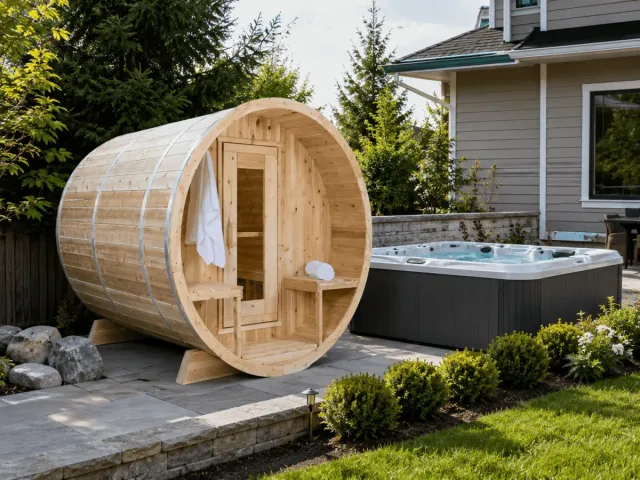
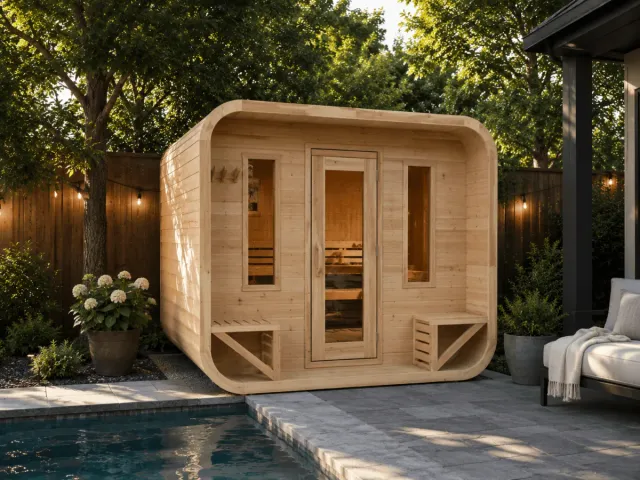
The Best Cedar Outdoor Saunas of 2026

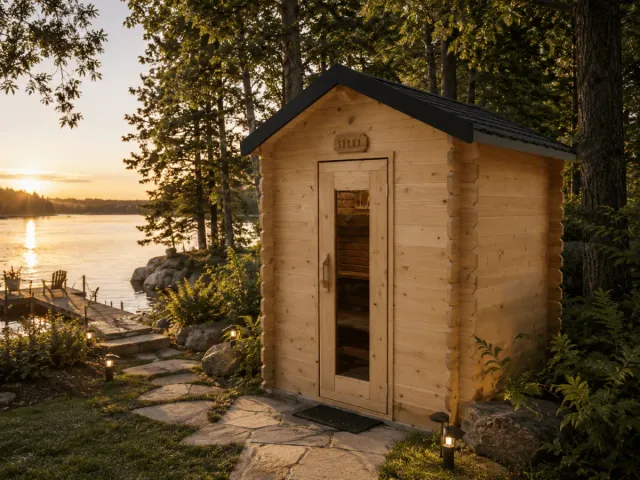
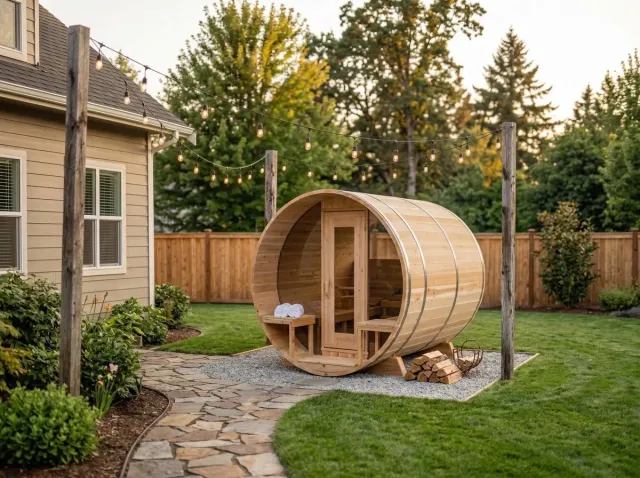
Cedar is the wood outdoor saunas were built from long before thermowood existed — naturally rot-resistant, dimensionally stable through heat cycles, and unmistakable in aroma. We ranked six cedar outdoor saunas across barrel and cabin formats, from a $5,668 white cedar cabin to a panoramic-glass flagship, comparing wall thickness, included hardware, heater requirements, and warranty.

Why Cedar Is the Traditional Outdoor Sauna Wood

A sauna that lives outdoors faces a harder life than any indoor room: rain, snow load, UV exposure, and the daily whiplash of heating to 190°F and cooling back to ambient. Cedar earned its place as the default outdoor sauna wood because it handles all of this without chemical treatment. The wood's natural oils resist moisture absorption, rot, decay, and insects — properties spruce and hemlock simply don't have at the same level — and its low density gives it two more advantages that matter every session: good insulation value, and surfaces that stay touchable at full operating temperature.

Cedar also behaves predictably under heat cycling, which is why barrel saunas — a format that depends on staves expanding and contracting in unison against tensioned bands — are overwhelmingly built from it. Two cedar species dominate the market. Eastern white cedar, milled in Canada by Dundalk Leisurecraft and True North, is lighter in color with tight knots and a subtler scent. Western red cedar, used in Almost Heaven's rustic-grade barrels, is the deeper reddish wood with the stronger aroma most people associate with the word "cedar." Both perform; the choice is aesthetic.

Every sauna in this ranking is verified cedar construction — no thermowood, spruce, or hemlock dressed up with cedar accents. Five of the six are made in Canada, which is not a coincidence: the Canadian white cedar supply chain feeds the manufacturers who have been building outdoor saunas the longest. If you're earlier in your research and haven't settled on a wood species yet, our full outdoor sauna ranking covers thermowood and spruce models alongside these, and our barrel sauna guide goes deeper on the stave-band format that most of these cedar models use — including band maintenance and red-vs-white cedar grades in barrel construction specifically.

Our Top Cedar Picks at a Glance

Dundalk Leisurecraft Tranquility MP Barrel Sauna

Best Overall Cedar

Dundalk Leisurecraft Tranquility MP Barrel Sauna

Handcrafted in Ontario from 1.5" eastern white cedar — and the only model here that combines a panoramic glass front, a built-in covered porch, and a rear half-moon window in a single unit.

From $8,275 2–5 person Barrel
Read Full Review
Dundalk Leisurecraft Serenity Barrel Sauna

Best Cedar Barrel

Dundalk Leisurecraft Serenity Barrel Sauna

The classic eastern white cedar barrel done right: 1.5" solid staves, marine-grade bands, a built-in covered porch, and benches wide enough to lie down — at a mid-range price.

$6,213 2–4 person Barrel
Read Full Review
True North Quattro Cedar Cabin Sauna

Best Premium Cedar

True North Quattro Cedar Cabin Sauna

A 5-person white cedar cabin handmade in Ontario with 1.55" solid walls, two front windows, two-tier benches, and your choice of wood stove or electric heat.

From $8,574 5 person Cabin
Read Full Review
Dundalk Leisurecraft Granby Cabin Sauna

Best Budget Cedar

Dundalk Leisurecraft Granby Cabin Sauna

The least expensive genuine cedar sauna we recommend: a 2-3 person eastern white cedar cabin with a 28-gauge steel roof and two-tier benches at $5,668.

$5,668 2–3 person Cabin
Read Full Review
Dundalk Leisurecraft Tranquility MP Barrel Sauna

Best Overall Cedar Sauna

Dundalk Leisurecraft Tranquility MP Barrel Sauna

The Tranquility MP from Dundalk Leisurecraft is the cedar outdoor sauna we'd recommend first, and the margin is wide. Handcrafted in Ontario from 1.5-inch solid eastern white cedar staves, it pairs cedar's natural rot resistance with the one thing most cedar barrels lack: light. The "MP" panoramic front — two full-length bronze tempered glass panels flanking a glass door — plus a half-moon rear window turns the typically enclosed barrel interior into something open and connected to the yard.

The cedar itself is the reason this sauna anchors a cedar-specific ranking. Eastern white cedar is paler than western red cedar, with tight knots and a subtler aroma, and it handles outdoor temperature cycling without excessive splitting or checking. Dundalk mills it to tight tolerances, and the 360-cubic-foot hot room is wrapped in solid cedar cradles and marine-grade aluminum bands fastened with stainless steel hardware — the corrosion-resistant combination you want on a structure that lives outside year-round.

Capacity is rated at 2–5 people, and the built-in 18-inch front porch with two seats gives you a covered cool-down area between rounds — a feature that meaningfully changes how often a sauna gets used from fall through spring. At 1,484 lbs, this is a substantial freight delivery, and assembly follows standard stave-and-band barrel construction — a weekend project for two people.

The heater is sold separately. Dundalk recommends an 8kW Harvia KIP class heater for this volume — its listing quotes 20–25 minutes to reach 195°F, drawing 33 amps at 240V and needing its own 50-amp circuit — or a wood stove for off-grid sites. This sauna also tops our barrel category in the site-wide rankings; on pure cedar quality, glass, and porch utility, nothing else here matches it.

Specifications

Style
Barrel with porch
Capacity
2–5 person
Material
Eastern white cedar (1.5" solid staves)
Dimensions
6'6" diameter × 9'10" length (incl. 18" porch)
Heat Source
Electric 8kW or wood-burning (sold separately)
Price
From $8,275

Features

  • Two full-length bronze tempered front glass windows
  • Half-moon bronze tempered rear glass window
  • Built-in 18" (45cm) front porch with two seats
  • Marine-grade aluminum bands with stainless steel hardware
  • Solid cedar cradles and flat floor
  • Pre-hung door with bronze tempered glass

Pros

  • Panoramic bronze tempered glass front plus half-moon rear window — the brightest cedar barrel interior here
  • 1.5" solid eastern white cedar staves, handcrafted in Canada
  • Integrated 18" covered porch gives you a seated cool-down spot between rounds
  • Marine-grade aluminum banding and stainless hardware hold up to decades outdoors
  • Pre-hung bronze tempered glass door simplifies the hardest assembly step

Cons

  • The real total includes a $1,200+ heater bought separately
  • Premium price for the cedar barrel category
  • Glass front and rear window give up some heat retention versus solid cedar walls

Things to Consider

  • Budget $1,200–$3,000 extra for the heater, which ships separately — an 8kW electric package or a wood-burning stove
  • Shipping weight is 1,484 lbs and the structure runs close to 10 feet with the porch — walk the route from curb to pad before ordering
  • Like all white cedar, the exterior drifts to silver-grey over time; oil it against UV once a year to hold the original tone
  • The 8kW heater class requires a dedicated 240V/50A circuit with 8-gauge wiring — budget for a licensed electrician
Dundalk Leisurecraft Serenity Barrel Sauna

Best Cedar Barrel Sauna

Dundalk Leisurecraft Serenity Barrel Sauna

If the Tranquility MP's panoramic glass is more sauna than you need, the Dundalk Serenity (CTC2245W) is the classic cedar barrel formula executed properly — and it's our pick for the best pure cedar barrel sauna. Same Canadian Timber Collection construction as the MP: handcrafted in Canada from 1.5-inch solid eastern white cedar, solid cedar cradles, and marine-grade aluminum bands with stainless steel tightening bolts instead of the galvanized steel bands common at this price.

The covered 18-inch front porch with its two integrated seats is the feature that separates the Serenity from most cedar barrels under $7,000. Cool-down between rounds is half the sauna ritual, and stepping onto a covered cedar porch instead of into open rain stretches your sauna season well into the colder months. Inside, the solid cedar benches are wide enough to lie down on — not a given in a barrel of this length, since the porch consumes part of the 94.8-inch overall length.

Dundalk rates capacity at 2–4 people, which translates to two or three adults with comfortable personal space. The 5mm bronze tempered glass door arrives pre-hung on the front wall, the flat cedar floor is removable, and the whole kit ships as pre-cut tongue-and-groove staves at 1,124 lbs.

The heater is sold separately: Dundalk's figure for the recommended 6kW Harvia KIP is 20–25 minutes to reach 195°F, drawing 25 amps at 240V on a dedicated 30-amp circuit, and a wood-burning stove is the alternative for sites without power. Priced at $6,213 and warranted for 5 years, this is the strongest price-to-construction ratio of any cedar barrel we evaluated.

Specifications

Style
Barrel with porch
Capacity
2–4 person
Material
Eastern white cedar (1.5" solid walls)
Dimensions
79.2" diameter × 94.8" length (incl. 18" porch)
Heat Source
Electric 6kW or wood-burning (sold separately)
Price
$6,213

Features

  • Built-in 18" (45cm) front porch with two seats
  • Marine-grade aluminum bands with stainless steel bolts
  • Pre-hung door with bronze tempered glass (5mm)
  • Removable flat cedar floor
  • Solid cedar cradles included
  • Pre-cut tongue & groove white cedar kit

Pros

  • 1.5" solid eastern white cedar, handcrafted in Canada
  • Covered 18" porch with two integrated seats — rare under $7,000
  • Marine-grade aluminum banding with stainless bolts — a corrosion upgrade over galvanized steel
  • Solid cedar benches wide enough to lie down
  • Removable flat cedar floor and pre-hung bronze tempered glass door

Cons

  • Factor in $1,200+ for the separately sold heater
  • 2–4 person rating realistically means 2–3 adults
  • No windows beyond the door glass — dimmer interior than the Tranquility models

Things to Consider

  • Dundalk recommends pairing it with the 6kW Harvia KIP electric (dedicated 240V/30A circuit) or a wood stove kit — neither is included
  • Part of the 94.8" length goes to the porch, so the hot room itself fits 2–3 adults comfortably
  • Plan for band re-tightening during the first season as the cedar staves acclimate to heat and humidity cycles
  • Eastern white cedar weathers to silver-grey outdoors without annual UV oil treatment
True North Quattro Cedar Cabin Sauna

Best Premium Cedar Sauna

True North Quattro Cedar Cabin Sauna

The True North Quattro is the premium cedar pick for buyers who want a genuine 5-person cabin rather than a barrel. Handmade in Ontario, Canada from white cedar with 1.55-inch solid walls — the thickest cedar walls on this list — it's an 8-foot-wide cabin built specifically for outdoor exposure, with details most kit saunas skip: fascia boards protecting the end grain of the wood, a roof membrane with a second layer of roof boards as standard, and partially pre-assembled construction with built-in venting holes.

White cedar is the same species story as Dundalk's barrels — strong, naturally resistant to rot and decay, with a light-colored finish — but the cabin format uses it differently. Vertical walls mean standing headroom throughout the 7-foot-tall interior, and the two-tier benches seat five people or let two recline across different heat zones. Two front windows are standard, with an optional rear window for cross-light.

The configuration options are the Quattro's real strength. The base 6-foot-deep cabin is $8,574; a 7-foot version adds a 1-foot covered porch ($9,074) and the 8-foot version adds a 2-foot covered porch with seating ($9,574). Critically, the Quattro accepts either a wood stove or an electric heater — the cabin's footprint and venting are designed for both, which makes it the strongest cedar option here for off-grid or cottage sites.

Trade-offs: the heater is sold separately in every configuration, True North quotes a heat-up time of around 30 minutes depending on outside temperature, and the company backs the structure with a 1-year warranty — far shorter than Dundalk's 5 years. You're paying for wall thickness, capacity, and Ontario handwork; if warranty length is your deciding factor, the Dundalk models above are the safer bet.

Specifications

Style
Cabin
Capacity
5 person
Material
White cedar (1.55" solid walls)
Dimensions
8' wide × 6'/7'/8' deep (porch option) × 7' tall
Heat Source
Wood stove or electric heater (sold separately)
Price
From $8,574

Features

  • Two front windows standard, optional rear window
  • Two-tier benches for sitting or reclining
  • Optional 1' or 2' covered porch with seating
  • Roof membrane plus second layer of roof boards
  • Fascia boards protect end grain from weather
  • Partially pre-assembled with built-in venting

Pros

  • Thickest cedar walls here at 1.55" solid white cedar
  • Genuine 5-person two-tier seating with standing headroom
  • Wood stove or electric heater — both supported by design
  • Roof membrane, second layer of roof boards, and fascia boards standard
  • Handmade in Ontario with optional 1' or 2' covered porch

Cons

  • 1-year warranty is the weakest in this roundup
  • Heater sold separately in all configurations
  • At $8,574+ before the heater, total cost lands near five figures

Things to Consider

  • 1-year warranty is the shortest on this list — Dundalk offers 5 years and Almost Heaven a limited lifetime structure warranty
  • Heater sold separately — choose between a wood stove or an electric heater at purchase
  • 8-foot width needs a larger level pad than a barrel — plan the site before ordering
  • Porch versions extend depth to 7 or 8 feet — confirm total footprint including roof overhang
Dundalk Leisurecraft Granby Cabin Sauna

Best Budget Cedar Sauna

Dundalk Leisurecraft Granby Cabin Sauna

The Dundalk Granby (CTC66W) is the least expensive sauna on this list, and it gets there without substituting cheaper wood — it's the same eastern white cedar as Dundalk's barrels, in a compact cabin format. Dundalk cites a 30+ year lifespan for the cedar, which resists decay and insects naturally, starts light-colored, warms to amber with heat exposure, and weathers to silver-grey outdoors if left untreated.

What you give up at $5,668 is space, not build quality. The interior is 5' × 5' with a 7-foot ceiling peak — a 2–3 person sauna in honest terms, sized for a couple. The two-tier bench arrangement on the back wall comes with a return L-bench that can be installed on the left or right side, so you can sit upright on the upper tier or lie down across the lower one. A 5mm bronze tempered glass door and adjustable vents round out the hot room.

The roof is the spec that stands out at this price: 28-gauge steel panels in matte black over a roof membrane — a premium metal shingle roof where most budget cabins ship asphalt roll roofing. Combined with the pre-cut, pre-milled cedar kit, two people can assemble the Granby in 5–8 hours with no cutting required.

The heater is sold separately; the Granby's compact volume heats in roughly 20 minutes depending on outside temperature, and it pairs with affordable 4.5–6kW electric heaters drawing 25 amps at 240V — the cheapest heater class to buy and to wire. Delivery is free curbside, but offloading the 1,230-lb crate from the truck is your responsibility, so arrange help or forklift access ahead of time.

Specifications

Style
Cabin
Capacity
2–3 person
Material
Eastern White Cedar (1.5" solid walls)
Dimensions
6'2" × 6'2" × 8'1" (exterior incl. roof); 5' × 5' × 7' peak (interior)
Heat Source
Electric 4.5–6kW (sold separately)
Price
$5,668

Features

  • 28-gauge steel roof panels, matte black, with membrane
  • 2-tier benches with return L-bench, left or right install
  • 5mm bronze tempered glass door
  • Adjustable vents for heat control
  • Flat floor
  • Pre-cut, pre-milled cedar — no cutting during assembly

Pros

  • Cheapest path to a true cedar outdoor sauna in this roundup at $5,668
  • 28-gauge matte black steel roof — premium roofing at a budget price
  • Two-tier benches with configurable return L-bench (left or right install)
  • Compact volume heats in roughly 20 minutes and runs on affordable 4.5–6kW heaters
  • Assembles in 5–8 hours with no cutting, made in Canada

Cons

  • 2–3 person capacity rules out group sessions
  • Heater sold separately adds to the total
  • 5' × 5' interior means no full recline for taller adults

Things to Consider

  • Heater sold separately — a 4.5–6kW electric heater is the recommended class for the compact interior
  • Curbside freight delivery: offloading the 1,230-lb crate from the truck is the customer's responsibility
  • 2–3 person capacity is genuinely compact — couples are the target user, not groups
  • Skip the yearly UV oil and the cedar will quietly go silver-grey — purely cosmetic, but worth knowing upfront
Dundalk Leisurecraft Harmony Barrel Sauna

Best Compact Cedar Barrel Sauna

Dundalk Leisurecraft Harmony Barrel Sauna

The Dundalk Harmony (CTC22W) is the entry point into Dundalk's Canadian Timber barrel line — the most compact barrel they make at roughly 1,054 lbs, with a footprint of 79.2 inches in diameter by 79.2 inches long. If your pad, budget, or delivery access can't handle the Serenity or Tranquility, the Harmony delivers the identical material story in less space: handcrafted Canadian eastern white cedar with tight knots, 1.5-inch solid walls, and marine-grade aluminum bands with stainless steel tightening bolts.

Dundalk's pitch for this model is simplicity, and it holds up: the kit installs in one day with zero cutting required. The 5mm bronze tempered glass door arrives pre-hung on the front wall, the flat floor is removable, and the solid cedar benches are sturdy enough for sitting upright or lying down — though at 6'7" of barrel length with no porch, lying down is realistic for one person at a time.

The honest framing on capacity: 2–4 people per Dundalk, which means two adults comfortably, three in close contact. What you don't get versus the Serenity for roughly $180 more is the covered porch — and we think most buyers in wet climates should stretch for it. But if every inch of your site matters, the Harmony is the smallest genuine cedar barrel footprint on this list.

The heater is sold separately. Dundalk lists 20–25 minutes to 195°F with the recommended 6kW Harvia KIP on a dedicated 240V/30A circuit, and wood-fired stoves are supported for off-grid installs. Five-year warranty, made in Canada.

Specifications

Style
Barrel
Capacity
2–4 person
Material
Eastern white cedar (1.5" solid walls)
Dimensions
79" diameter × 86¼" overall height (per Dundalk drawings), incl. front porch
Heat Source
Electric 6kW or wood-burning (sold separately)
Price
$6,032

Features

  • Marine-grade aluminum bands with stainless steel bolts
  • Pre-hung door with bronze tempered glass (5mm)
  • Removable flat floor
  • Solid cedar benches for sitting or lying down
  • Solid cedar cradles included
  • One-day install with zero cutting

Pros

  • Smallest cedar barrel footprint here — fits tight sites and smaller pads
  • Same 1.5" eastern white cedar and marine-grade bands as Dundalk's larger barrels
  • Installs in one day with no cutting required
  • Lightest Dundalk barrel at approximately 1,054 lbs — the easiest delivery
  • Removable flat floor and pre-hung bronze tempered glass door

Cons

  • No covered porch — the Serenity adds one for ~$180 more
  • The heater purchase ($1,200 and up) comes separately
  • 2–4 person rating means two adults in real comfort

Things to Consider

  • Heater sold separately — 6kW electric (dedicated 240V/30A circuit) or a wood stove are the recommended pairings
  • No porch — for $181 more, the Serenity adds a covered cool-down area
  • 6'7" barrel length limits lying down to one person at a time
  • Expect first-season band re-tightening as the cedar acclimates to heat cycles
Almost Heaven Pinnacle Barrel Sauna

Best Red Cedar Barrel Sauna

Almost Heaven Pinnacle Barrel Sauna

Every other sauna in this ranking is white cedar; the Almost Heaven Pinnacle is here for a different customer — the one who pictures red cedar when they hear "cedar sauna": deeper reddish color, a stronger and more resinous aroma. Red cedar's oils naturally repel moisture before it can soak into the wood, and the rustic grade's knots and character marks are structurally sound; many buyers actively prefer the look.

The Pinnacle's strongest argument in a cedar shoot-out is what's included. A 6kW Harvia KIP electric heater comes standard in the starting price — every Dundalk and True North model above sells its heater separately at $1,200–$3,000 — so the Pinnacle's effective total-cost gap versus the cheaper-looking listings narrows dramatically. Add lifetime structural coverage with a 5-year term on heater components — the longest protection of any cedar sauna here — and it's the lowest-risk complete package on this page.

The sauna itself is a 6' × 6' barrel that assembles via Almost Heaven's stave-band system in 4–5 hours for two people — the staves ship cut to length and numbered, and tightening the steel bands in sequence trues the cylinder as you go, so the kit does the precision work rather than your saw. At order time you decide how the barrel is finished: which door (all glass or half wood), whether the back wall stays blank or gets a porthole or the larger vista pane, and whether the heater steps up to a Fenix-controlled KIP Smart or Spirit Smart.

The trade-offs are the same ones we noted in our site-wide review: the 4-person rating realistically seats 2–3 adults, the compact 6-foot length limits stretching out, and red cedar's cut ends will check and split cosmetically over time — normal for outdoor cedar, not structural. The included 6kW heater needs a dedicated 240V/30A circuit.

Specifications

Style
Barrel
Capacity
4 person (comfortably 2–3 adults)
Material
Rustic red cedar
Dimensions
6' diameter × 6' length
Heat Source
Electric (6kW Harvia KIP included) with Smart upgrade options
Price
From $8,164

Features

  • Pre-cut numbered stave panels
  • Galvanized steel tightening bands
  • Configurable door style (glass or half-and-half)
  • Optional rear window (port or vista)
  • Interior two-tier bench seating
  • Adjustable floor vent

Pros

  • Only red cedar option here — richer color and stronger cedar aroma than white cedar
  • 6kW Harvia KIP heater included — no separate $1,200–$3,000 purchase
  • Limited lifetime structure warranty with 5-year heater component coverage
  • Pre-cut, numbered staves and sequential band tightening keep assembly predictable
  • Configurable door, rear window, and heater upgrades at purchase

Cons

  • Despite the 4-person label, two or three adults is the comfortable reality
  • At six feet end to end, there's no room to lie back
  • Galvanized steel bands rather than the marine-grade aluminum Dundalk uses

Things to Consider

  • The $8,164 sticker narrows fast against heater-separate kits once you price in their $1,200–$3,000 heater purchase
  • Barrel must be elevated on level cradles or a gravel pad; ground contact accelerates bottom stave rot
  • Checking and splitting on the red cedar's cut ends is part of how the wood weathers — a cosmetic quirk, not a structural problem
  • Wiring the included 6kW heater calls for a dedicated 240V/30A circuit — price in a licensed electrician

Cedar vs Thermowood: Which Should You Buy?

The most common fork in outdoor sauna research is cedar versus thermowood — heat-treated spruce or pine whose cellular structure has been permanently altered so it absorbs almost no moisture. Both are legitimate outdoor materials; they get there differently, and the differences map onto buyer priorities cleanly.

Buy cedar if you want the traditional experience. Cedar's case rests on what treatment can't replicate: the aroma that fills the hot room from the first session, natural insect resistance, the classic appearance (light amber for white cedar, rich red-brown for red cedar), and a centuries-long track record outdoors. Cedar's natural oils do the moisture-resistance work, so there's no treated layer to wear through — the protection runs the full depth of the board. The cost is modestly higher maintenance: an annual exterior UV oil application if you want to keep the original color, and on barrels, band re-tightening in the first season as the staves acclimate.

Consider thermowood if minimum maintenance is the priority. Because thermally modified wood barely absorbs water, it's slightly more dimensionally stable through freeze-thaw cycles and demands less attention in persistently wet climates. The trade: little to no aroma, a darker caramel tone that doesn't read "cedar," and the heat treatment makes the wood somewhat more brittle than cedar of the same dimension. Pricing overlaps heavily — neither material is reliably cheaper at equal build quality.

Our honest framing: this is a preferences decision, not a correctness decision. The cedar saunas on this page will outlast their heaters with basic care, and so will a good thermowood build. For a full walkthrough of every sauna wood species — including aspen, spruce, and hemlock interiors — see the wood types section of our sauna buying guide.

Cedar Sauna Maintenance: What to Expect

Cedar's reputation for durability sometimes gets misread as "maintenance-free." It isn't — it's maintenance-light, on a predictable schedule. Here's the realistic annual rhythm for the saunas on this list.

Exterior: One Treatment a Year

Left untreated, cedar weathers to a silver-grey patina within two to three seasons of sun exposure. This is cosmetic — the wood underneath remains sound — and some owners prefer the aged look. If you want to keep the original tone, apply a UV-protective penetrating oil to the exterior once a year, ideally before your wettest season. Never use film-forming finishes like paint or polyurethane outdoors: they trap moisture and peel under heat cycling. The interior gets no finish at all, ever — bare cedar handles sauna humidity exactly as designed, and coatings can off-gas at operating temperature.

Barrels: Bands and Foundations

The four barrel models here (Tranquility MP, Serenity, Harmony, Pinnacle) share two format-specific tasks. First, band tightening: cedar staves swell and contract through the first season's heat cycles, so expect to re-tighten the bands two or three times in year one, then roughly annually after the wood acclimates. Second, elevation: the barrel must sit on its cradles over a drained surface — compacted gravel is ideal — because bottom-stave contact with wet ground is the single most common cause of premature failure in any cedar barrel. The barrel sauna guide linked above covers foundations and band technique in detail.

Heaters: The Component That Ages First

On a maintained cedar sauna, the structure is rarely what fails — the heater is. Electric elements and controls typically want attention around years 7–10 of regular use, well inside the lifespan of the cedar shell. Four of our six picks sell the heater separately, which is a real budget line ($1,200–$3,000 for the recommended electric packages) but also a long-term advantage: you can choose the brand, wattage, and control style deliberately, and replace it without touching the structure. Our best sauna heaters guide compares the Harvia, HUUM, and Saunum options these manufacturers recommend.

Frequently Asked Questions

Is cedar a good wood for an outdoor sauna?

Yes — cedar is the traditional North American choice for outdoor saunas, and the reasons are functional, not nostalgic. Cedar's natural oils resist moisture absorption, rot, decay, and insects without any chemical treatment, which matters enormously for a structure that lives outside through rain, snow, and humidity swings. Cedar is also dimensionally stable through heat cycling — it expands and contracts predictably as the sauna heats and cools, which is why it dominates stave-band barrel construction. And it has low thermal conductivity, so interior surfaces stay touchable at operating temperature. The main trade-offs are price (cedar costs more than spruce or hemlock) and cosmetic weathering: untreated cedar silvers to grey outdoors over a few seasons.

Can a cedar sauna stay outside all year?

Yes. Cedar saunas are designed for permanent outdoor installation in all four seasons, including freeze-thaw climates — every model on this list is built specifically for it. Three things determine how well a cedar sauna weathers year-round exposure: the foundation (keep the structure elevated on cradles, gravel, or pavers so the bottom boards never sit in wet ground — ground contact is the most common cause of premature rot), the roofline (barrels shed rain and snow passively; cabins like the Dundalk Granby use steel roofing or membranes), and annual exterior treatment with a UV-protective oil if you want to preserve the original color. Cold weather doesn't harm the wood — it just extends heat-up times.

How long will a cedar sauna last outside?

A well-maintained cedar outdoor sauna typically lasts 15–25 years, and the cedar structure itself often outlives the components around it — plan on heater elements and door hardware needing attention at years 7–10 with regular use. Dundalk cites a 30+ year lifespan for the eastern white cedar used in its Canadian Timber saunas. The variables that move the number: foundation quality (elevation and drainage under the structure), band maintenance on barrels (loose bands let staves gap and admit water), sun exposure (UV is what degrades the surface fastest), and whether the exterior gets an annual protective oil treatment. A neglected sauna on wet ground can fail in under a decade; a maintained one on a proper pad can serve a generation.

What's the difference between eastern white cedar and western red cedar?

Both are excellent sauna woods — the differences are appearance, aroma, and sourcing more than performance. Eastern white cedar (used by Dundalk and True North, both milling Canadian timber) is lighter in color with tight knots, has a subtler aroma, and warms to an amber tone with heat exposure. Western red cedar (used in the Almost Heaven Pinnacle's rustic red cedar) is the deeper reddish-brown wood most people picture, with a stronger, more resinous cedar scent. Both resist rot and decay naturally, both handle outdoor temperature cycling well, and both weather to silver-grey without treatment. Choose by the look and aroma you prefer — neither is functionally superior for outdoor use.

Is cedar better than thermowood for an outdoor sauna?

They solve the same problem — outdoor durability — by different mechanisms, and both work. Cedar resists moisture through natural oils; thermowood (heat-treated spruce or pine) resists it because high-temperature treatment permanently changes the wood's cellular structure so it absorbs almost no water. In practice: thermowood is slightly more dimensionally stable and needs less maintenance in wet climates, while cedar offers the classic aroma, the traditional appearance, and natural insect resistance that thermowood's treatment doesn't add. Cedar barrels need a bit more first-season band attention as the staves acclimate. Neither choice is wrong — if you want the cedar experience, buy cedar; if you want minimum maintenance in a rain-heavy climate, thermowood is worth considering.

Do you need to seal or stain a cedar sauna?

The exterior benefits from treatment; the interior should never be sealed. Outside, untreated cedar weathers to a silver-grey patina within a few seasons — structurally harmless, and some owners like the look. If you want to keep the original tone, apply a UV-protective penetrating oil to the exterior once a year. Avoid film-forming finishes (polyurethane, paint, varnish) outside: they trap moisture in the wood and peel under temperature cycling. Inside the hot room, leave the cedar completely bare — sealers and stains can off-gas at sauna temperatures and block the wood's natural moisture handling. Interior maintenance is simply a rinse-down and occasional light sanding of bench surfaces.

What is the 200 rule for saunas?

The "rule of 200" is a comfort guideline for traditional saunas: the air temperature in °F plus the relative humidity percentage should total around 200 or less. At 180°F, that means keeping humidity around 20% or below; at 160°F, you have room for more steam. It's a rule of thumb rather than a safety standard, but it's useful for learning how water on the rocks changes the feel of a session — adding steam raises perceived heat sharply, so a lower-temperature sauna with generous steam can feel as intense as a hotter, drier one. Cedar saunas with traditional electric or wood-fired heaters handle the full range; just add water to the stones gradually until you find your total.