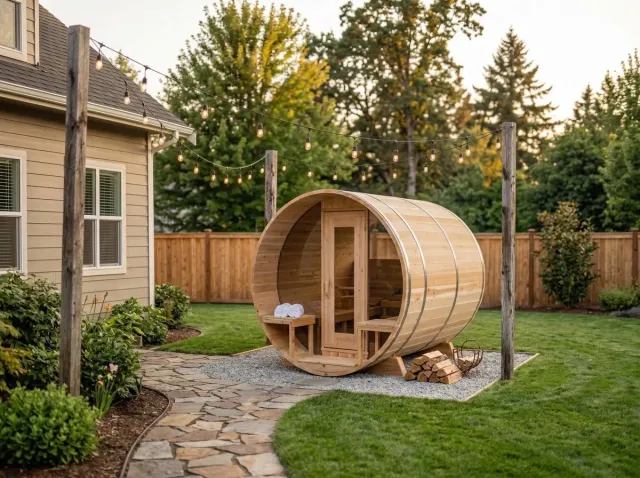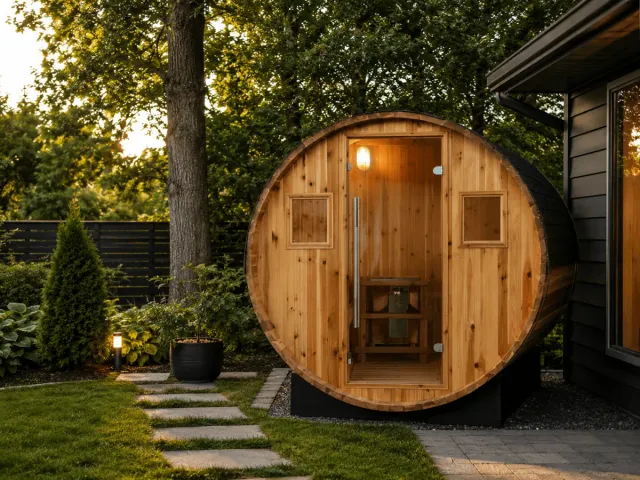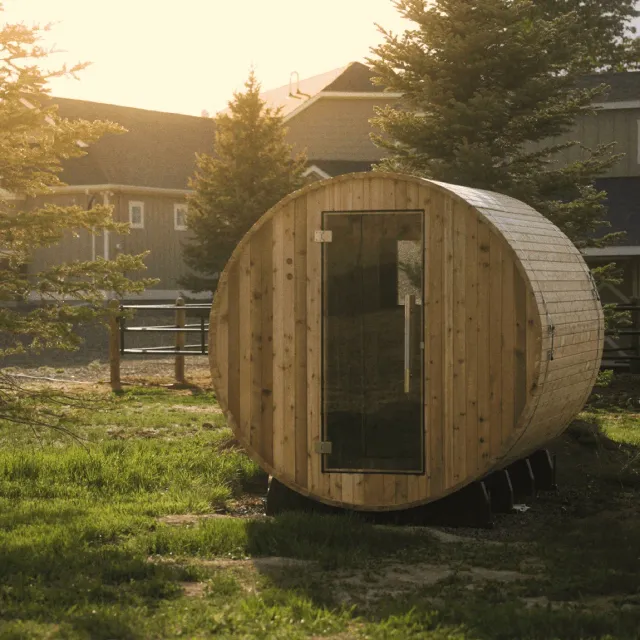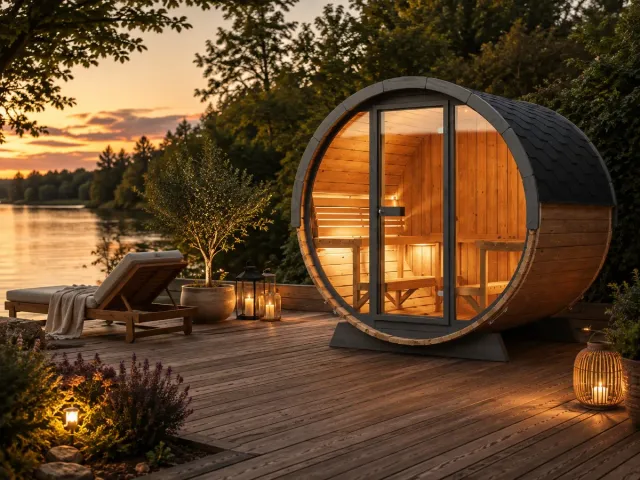
The Best Barrel Saunas of 2026

Barrel saunas are the most popular outdoor sauna format in North America — efficient to heat, natural at shedding rain and snow, and built from cedar that improves with age. If you have not settled on the format yet, our barrel vs cabin comparison covers that decision first. We researched and compared five barrel saunas across price points, wood species, and heater configurations to find the best for every backyard.

Disclosure: BestOutdoorSaunas is published by Fox2Web UG, which shares an owner with Topture — one of several retailers we link to. Our ranking criteria are published on every page. We may earn a commission from links on this page, at no extra cost to you.

Why Choose a Barrel Sauna?

The barrel sauna's popularity is not purely aesthetic. The cylindrical geometry creates a measurable performance advantage over rectangular cabin designs: a cylinder encloses a given volume of air using the minimum possible surface area for that volume. Less surface area means less wood for heat to conduct through, less thermal mass to pre-heat, and less total airspace to warm before the sauna reaches usable temperature. Most 4-person barrel saunas reach operating temperature faster than a cabin of equivalent capacity when fitted with a properly sized electric heater, because there is less air volume and less wall area to heat.

The heat distribution inside a barrel is also distinctly even. In a rectangular sauna, convective air currents create temperature gradients — hotter near the heater, cooler in corners away from the heat source, with variable zones near the door where cold infiltration interrupts circulation. In a barrel, the curved walls guide rising warm air in a continuous circular pattern that consistently returns to the bench level. There are no dead corners. The consequence, and this is our reading of the geometry rather than a measured result, is that a barrel can feel warmer than a cabin set to the same thermostat temperature: with no roof corners for warm air to stratify into, more of the heat stays at bench level where a bather actually sits.

Weather performance is another genuine barrel advantage. The curved roof sheds rain and snow without ponding or accumulation. Flat-roofed cabin saunas require roofing membranes, snow guards, and periodic maintenance to manage water that the barrel's shape handles passively. In Pacific Northwest rain climates or Upper Midwest winters, this difference accumulates into meaningfully less maintenance and less risk of moisture-related wood deterioration over the sauna's lifespan.

The barrel format also dominates the under-$6,000 market for a structural reason: the stave-band construction system lends itself to flat-pack shipping at lower cost than cabin-style panel assemblies. Six-person cabin saunas typically ship on multiple pallets of pre-built wall sections; an equivalent barrel sauna ships as a manageable stack of identical staves and a hardware kit. The logistics cost difference is real and translates directly to price. Buyers in the $3,000–$6,000 range will almost always find more sauna per dollar in the barrel format than in a cabin equivalent, and our cost breakdown works through what a finished barrel project actually totals. See all our top-rated models across sauna types in our best outdoor saunas guide.

Most barrel saunas use traditional electric heaters, though some manufacturers offer infrared panel options in smaller barrel models. For a detailed comparison of heating methods, see our infrared vs traditional sauna guide.

Regular sauna use provides documented health benefits including cardiovascular support, muscle recovery, and stress reduction — all of which apply equally to barrel sauna use.

Compare Barrel Saunas at a Glance

SaunaLife EE8G Barrel Sauna

Best Overall Barrel Sauna

SaunaLife EE8G Barrel Sauna

The SaunaLife EE8G is our best overall barrel because it solves the barrel format's oldest weakness — the wood. Almost every barrel sauna on the market is untreated cedar, which survives outdoors on its natural oils alone and eventually checks, greys and softens at the ground-facing staves. The EE8G's 1.65-inch staves are thermo-spruce: Nordic spruce kiln-treated at high temperature until the sugars that feed rot and the cell structure that absorbs water are both destroyed. The result is a stave that takes on far less moisture than untreated timber, moves far less through freeze-thaw cycles, and needs no chemical preservative to get there.

The practical consequence is band maintenance. Cedar barrels swell and shrink through their first heat cycles, which is why every cedar barrel on this page needs its bands re-tightened two or three times in year one. Thermo-spruce moves considerably less, so the EE8G settles faster and stays settled — a small thing on paper that matters a great deal to anyone who does not want to be out in the yard with a ratchet each spring.

Inside, the benches and backrests are knot-free thermo-aspen at 1.1 inches. Aspen has low thermal conductivity, so the bench surface stays touchable at full operating temperature — no towel needed to sit down, and no knots to press into your back. The interior stands 6'7", which is the number that separates this from the rest of the field: it is the only barrel in this roundup an adult of average height can stand up straight inside. The 8mm tempered glass front wall and bronze-tempered door turn what is normally a dark tube into a room with a view.

At 244 cubic feet SaunaLife rates it "up to 6 bathers" with a 4-person seated capacity, and 4 adults is the honest working number. The heater is sold separately — budget $1,317 and up, which is the one real cost asterisk on this pick. Factor that in and the EE8G lands around $8,500 all-in, above the cedar barrels here but below the two-room Shenandoah. The shingled roof kit with drip rails, dual floor drains and Wi-Fi app-controlled LED lighting are included rather than upsold.

Specifications

Style
Barrel
Capacity
6 person (comfortably 4 adults)
Material
Thermo-Spruce staves (1.65") with knot-free Thermo-Aspen benches (1.1")
Dimensions
79" L × 91" diameter (exterior); 71" L × 87" diameter (interior)
Heat Source
Electric or wood, sold separately ($1,317+)
Price
$7,190

Features

  • 1.65" thermo-spruce staves
  • 8mm tempered glass front wall
  • Bronze-tempered door (5/16")
  • 6'7" stand-up interior height
  • Wi-Fi app-controlled LED lighting with remote
  • Shingled roof kit with drip rails
  • Dual floor drains
  • Stainless steel bands (1-7/8" × 1/8")

Pros

  • Thermo-spruce staves resist rot and moisture without chemical treatment — the most durable wood in this roundup
  • 6'7" interior height is the only stand-up barrel on this page
  • Knot-free thermo-aspen benches stay cool to the touch at full temperature
  • Full 8mm tempered glass front wall and bronze-tempered door
  • Lifetime limited warranty on the structure
  • Roof kit, dual floor drains and Wi-Fi LED lighting included, not upsold

Cons

  • Heater sold separately adds $1,317+ to the real budget
  • No cedar aroma — thermo-spruce is effectively scentless
  • "Up to 6 bathers" is optimistic; 4 adults is the comfortable number

Things to Consider

  • Heater is sold separately — budget $1,317 and up for a compatible electric unit, which puts the realistic all-in cost near $8,500
  • Thermo-spruce is a lighter, more uniform blond than cedar and has almost no aroma — if the cedar smell is part of what you're buying, the Dundalk Harmony below is the pick
  • 91" diameter needs a genuinely level pad with working clearance all the way around for band access
  • Freight is curbside only and the unit ships on a pallet — plan unloading before delivery day
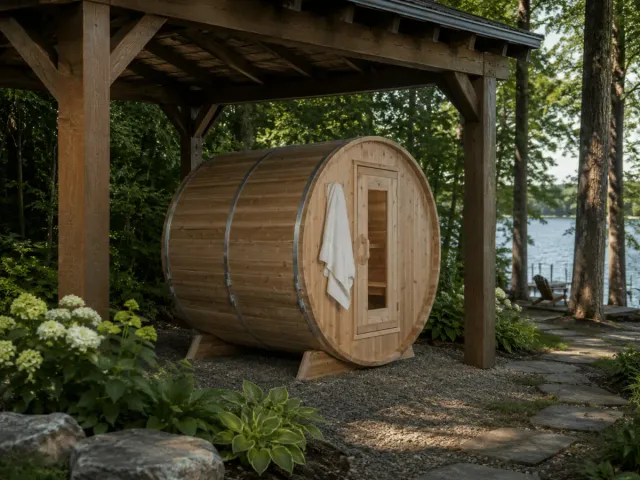
Dundalk Leisurecraft Harmony Barrel Sauna

Best Canadian Cedar Barrel Sauna

Dundalk Leisurecraft Harmony Barrel Sauna

If the thermo-spruce EE8G is the engineering answer to outdoor barrel saunas, the Dundalk Harmony is the traditional one — and it is very good at being traditional. The staves are 1.5-inch solid Eastern White Cedar, milled in Canada from Canadian timber, and they are noticeably thicker than the 1-3/8" lumber Almost Heaven uses and thicker than most imported barrels. Thickness matters twice over: more thermal mass means the barrel holds heat longer between door openings, and more material means more margin before weathering becomes structural.

Eastern white cedar is the lighter, tighter-knotted cousin of the western red cedar most people picture. The aroma is subtler and the colour warms to amber rather than deep red-brown with heat exposure. Left untreated it silvers over a few seasons, which many owners prefer and which does nothing to the wood underneath — cedar's natural oils repel moisture without any help.

The Harmony's distinguishing feature is the built-in porch with two seats, carved out of the barrel's length rather than bolted on. Cooling down is half of a real sauna session, and having a shaded, dry place to do it three feet from the door — rather than standing on wet grass — changes how the sauna actually gets used. It costs interior length to get it, which is the honest trade.

The heater is sold separately, and Dundalk's own pairings are well documented: a Harvia KIP 6kW reaches 195°F in 20–25 minutes, or the HUUM DROP 6kW hits 230°F in the same window per the listing. A Harvia M3 wood stove is the off-grid option. At $6,032 plus roughly $1,317 for the heater, the Harmony lands near $7,350 all-in — the mid-point of this page, with the five-year warranty being the one place it trails the lifetime coverage above and below it.

Specifications

Style
Barrel with covered porch
Capacity
2–4 person
Material
Eastern white cedar (1.5" solid walls)
Dimensions
79" diameter × 86¼" overall height (per Dundalk drawings), incl. front porch
Heat Source
Electric or wood, sold separately (Harvia KIP 6kW, HUUM DROP 6kW, or Harvia M3)
Price
$6,032

Features

  • 1.5" solid Eastern White Cedar staves
  • Built-in porch with two seats
  • Full-sized door with bronze-tempered window
  • Marine-grade aluminum bands with stainless bolts
  • Solid cedar benches
  • Flat removable floor
  • Assembles in one day with no cutting

Pros

  • 1.5" solid Eastern White Cedar is the thickest stave on this page
  • Built-in two-seat covered porch for cool-down without leaving the structure
  • Genuine Canadian milling and timber
  • Documented heater pairings with published heat-up times (195°F in 20–25 min with Harvia KIP 6kW)
  • Marine-grade aluminum bands with stainless tightening bolts
  • Flat removable floor makes cleaning straightforward

Cons

  • Five-year warranty against lifetime coverage on the SaunaLife and Almost Heaven picks
  • Heater sold separately adds $1,317+
  • Porch consumes length that would otherwise be bench space

Things to Consider

  • Heater sold separately — roughly $1,317 for the Harvia KIP 6kW pairing, putting all-in cost near $7,350
  • Five-year warranty is the shortest structural coverage on this page
  • Expect to re-tighten the bands two or three times in the first year as the cedar acclimates, then roughly annually
  • 1,054 lbs on a pallet — curbside freight means you arrange the move to the pad
Dundalk Leisurecraft Tranquility MP Barrel Sauna

Best Large Barrel Sauna

Dundalk Leisurecraft Tranquility MP Barrel Sauna

The Tranquility MP is the Harmony's argument extended by three feet and a glass wall. Same 1.5-inch solid Eastern White Cedar, same Canadian milling, same built-in porch — but at 118 inches deep it seats a genuine group rather than a couple and a guest, and the MP designation brings a full glass front in place of the Harmony's single door window.

The glass front is the reason to pay the difference. A conventional barrel is a dark tube with a porthole; a full glass wall makes it a room that happens to be cylindrical, and it substantially changes evening use — you can see out, and the interior lighting reads from the house. It also changes the heat maths slightly: glass is a worse insulator than 1.5 inches of cedar, which is why Dundalk's recommended pairing steps up to a Harvia KIP 8kW or HUUM DROP 7.5kW rather than the 6kW units that suit the Harmony.

Dundalk rates it 6-person and describes 2–5 as the working range, which is the more honest figure once the porch seating is separated out from the hot room. Heat-up is quoted at 195–230°F in 20–25 minutes depending on which heater you choose, per the retailer's listed pairings. The heater is again sold separately, so budget from $1,317; at $8,275 for the barrel the realistic all-in is around $9,600.

Two details worth knowing before you commit the yard space: the footprint is close to ten feet in one dimension, so it needs a genuinely large level pad, and freight for a unit this size is where the "curbside delivery" line in the small print becomes a real logistics problem rather than a footnote. Read the delivery terms before you order, not after.

Specifications

Style
Barrel with glass front and porch
Capacity
2–5 person
Material
Eastern white cedar (1.5" solid staves)
Dimensions
6'6" diameter × 9'10" length (incl. 18" porch)
Heat Source
Electric or wood, sold separately (Harvia KIP 8kW, HUUM DROP 7.5kW, or Harvia M3)
Price
From $8,275

Features

  • Full glass front wall
  • Built-in front porch with shaded seating
  • 1.5" solid Eastern White Cedar staves
  • Full-sized door with bronze-tempered window
  • Two solid cedar benches
  • Ready-to-assemble kit

Pros

  • Full glass front transforms interior light and evening usability
  • 1.5" solid Eastern White Cedar with genuine Canadian milling
  • Built-in porch provides shaded cool-down seating
  • Genuinely seats a group rather than a couple
  • Documented heat-up of 195–230°F in 20–25 minutes depending on heater
  • Bronze-tempered door glazing reduces daytime glare

Cons

  • Most expensive Topture-stocked pick here, and the heater is still separate
  • Five-year warranty trails the lifetime coverage elsewhere on this page
  • Footprint and freight logistics rule it out for tight or awkward sites

Things to Consider

  • Heater sold separately and steps up to 8kW for the glass front — budget from $1,317, all-in near $9,600
  • 118" depth needs a large, genuinely level pad with clearance for band access
  • Full glass front loses more heat than solid cedar — expect longer recovery between door openings
  • The largest unit on this page; confirm site access and unloading before ordering, as freight is curbside
SunRay Solace 200SH Barrel Sauna

Best Compact Barrel Sauna

SunRay Solace 200SH Barrel Sauna

The SunRay Solace 200SH is the pick for the buyer whose constraint is space rather than budget — though it happens to satisfy both. At 72 inches wide and 49 inches deep it is by some distance the smallest structure on this page, which makes it the only one that fits a small urban yard, a side return or a deck corner without redesigning the garden around it.

Crucially, the 6kW Harvia electric heater is included in the price. Every Dundalk and SaunaLife pick on this page sells its heater separately at $1,317 and up, so the Solace's $4,790 is a genuinely complete number in a way that the others' sticker prices are not. Compared like-for-like on all-in cost, it is the cheapest way onto this page by roughly $2,500.

The wood is solid red cedar with ball-and-socket joinery — the deeper red-brown, strongly aromatic cedar most people picture when they imagine a sauna, rather than the paler Eastern white the Dundalks use. It reaches 170–180°F, which is a real step below the 195°F+ the Harvia KIP and HUUM DROP pairings deliver elsewhere on this page. For most bathers that difference is comfortable rather than disappointing, but committed high-heat traditionalists should note it.

The limitation is simply size: this is a two-person sauna and the interior is 69 inches wide by 39 deep, so nobody is stretching out. The 10-year structural warranty is the longest on this page, though parts and electronics are covered for only 1 year. A built-in 8-hour delay-start timer, interior dome lighting, tempered glass door, floor levelling kit and a full accessory kit — bucket, ladle, thermo-hygrometer, sand timer and stones — all come in the box, which is more genuinely-included equipment than anything else here.

Specifications

Style
Barrel
Capacity
2 person
Material
Solid red cedar (1-3/8" lumber), ball-and-socket construction
Dimensions
76" H × 72" W × 49" D (exterior)
Heat Source
6kW Harvia electric heater included (220V, 30A)
Price
$4,790

Features

  • 6kW Harvia heater and stones included
  • Built-in 8-hour delay start timer
  • Tempered glass door
  • Interior dome lighting
  • Shingled roof
  • Flat floor levelling kit
  • Accessory kit: bucket, ladle, thermo-hygrometer, sand timer
  • Stainless steel hardware

Pros

  • 6kW Harvia heater included — the cheapest genuinely complete package on this page
  • Smallest footprint here at 72" × 49", fits sites the others can't
  • Solid red cedar with the strong traditional cedar aroma
  • Built-in 8-hour delay-start timer
  • Full accessory kit included: bucket, ladle, thermo-hygrometer, sand timer and stones
  • Rated for indoor or outdoor use

Cons

  • Genuinely two-person only
  • 170–180°F max temperature is the lowest on this page
  • 1-year parts warranty against lifetime structural coverage on the SaunaLife and Almost Heaven picks

Things to Consider

  • Two-person capacity is a hard limit — the interior is 69" × 39"
  • 170–180°F maximum is meaningfully below the 195°F+ available from the Dundalk and SaunaLife heater pairings
  • Requires a dedicated 220V 30-amp circuit — budget $300–$500 for an electrician if the yard isn't already wired
  • 1-year parts and electronics warranty is short, though the 10-year structural coverage is the longest here
Almost Heaven Shenandoah Barrel Sauna

Best Barrel Sauna With a Changing Room

Almost Heaven Shenandoah Barrel Sauna

The Shenandoah is the only sauna on this page that solves a problem none of the others address: where you get changed. It is a ten-foot barrel divided into a six-foot sauna room and a four-foot changing room behind its own door — the European configuration, and a format almost nobody offers in a barrel. If your sauna is fifty feet from the house, or you use it in a Midwestern February, or you simply do not want to walk back indoors damp, that four feet changes the whole experience in a way no spec sheet captures well.

It is built in the USA from 1-3/8-inch ball-and-socket cedar with stainless steel bands, hinges and fasteners — Almost Heaven mills in West Virginia, which makes this the only American-made pick on this page against Canadian (Dundalk) and European (SaunaLife) manufacture. The lumber is thinner than Dundalk's 1.5-inch staves, though the ball-and-socket joinery is a genuinely tight system that does not rely on band tension alone to stay sealed.

The heater is included, and at 8kW/9kW it is sized for the volume — this is a large room, and a 6kW unit would struggle. That inclusion matters to the arithmetic: at $10,650 with the heater in the box, the Shenandoah's real cost sits roughly $1,000 above the Tranquility MP's all-in figure rather than $2,400 above its sticker. Almost Heaven's limited lifetime structural warranty is the strongest coverage on this page alongside the SaunaLife, with the Harvia heater carrying 1 year on elements and 5 on other components.

This is the pick when the changing room is the deciding feature, and it is a real one. If it isn't — if you have a mudroom, or the sauna sits by the back door — then you are paying a considerable premium for four feet of unheated cedar, and the Tranquility MP gives you more hot room for less money.

Specifications

Style
Two-room barrel (sauna + changing room)
Capacity
6 person (comfortably 4 adults in the sauna room)
Material
Ball-and-socket cedar lumber (1-3/8") with stainless bands
Dimensions
82-3/8" W × 119" D × 85-7/8" H (assembled)
Heat Source
8kW/9kW Harvia electric heater included (240V, 40/45A)
Price
$10,650

Features

  • Separate 4-foot changing room with its own door
  • 6-foot sauna room
  • Harvia 8kW/9kW heater and stones included
  • Interior LED lighting
  • Stainless steel bands, hinges and fasteners
  • Tempered glass features
  • Made in the USA

Pros

  • Only two-room barrel here — dedicated 4-foot changing room behind its own door
  • 8kW/9kW Harvia heater and stones included in the price
  • Limited lifetime structural warranty
  • American-made in West Virginia
  • Ball-and-socket joinery seals independently of band tension
  • Stainless steel bands, hinges and fasteners throughout

Cons

  • Most expensive sauna on this page by a clear margin
  • 1-3/8" lumber is thinner than Dundalk's 1.5" staves
  • The changing room consumes four feet that could have been hot room
  • Heavier 40/45-amp electrical requirement

Things to Consider

  • The changing room is the entire value proposition — if you don't need one, the Tranquility MP is more hot room for less
  • 8kW/9kW heater requires a 40/45-amp 240V circuit, a heavier electrical run than the 30-amp units elsewhere here
  • 1-3/8" lumber is thinner than the 1.5" solid cedar on both Dundalk picks
  • Lead times run long — Almost Heaven quotes 6–8 weeks on comparable models and ships by flatbed

Barrel Sauna Buying Considerations

Barrel saunas share a common assembly system and format, but meaningful differences in wood species, size, heater configuration, and foundation requirements separate a well-chosen barrel from a disappointing one. Here are the six decisions that matter most.

Size and Person Capacity

Barrel sauna size is driven by interior length, with diameter being more consistent across manufacturers (typically 6'–8'). The common interior length categories are 6-foot (2–3 person practical capacity), 7-foot (3–4 person), and 8-foot-plus (5–6 person). The rated person capacity from manufacturers is consistently optimistic — reduce stated capacity by one to two people for a realistic comfortable-use estimate. A barrel "rated for 4 people" typically seats 2–3 adults with personal space, or 4 adults in close contact.

Diameter affects headroom more than length does. A 6-foot diameter barrel has a centerline height of approximately 5'6" at the peak — adequate for most adults seated on the bench, but tight for anyone who wants to stand and move freely. An 8-foot diameter barrel provides meaningful additional headroom at the peak. If you're tall or dislike feeling constrained, prioritize diameter alongside length when comparing models.

Wood Type for Barrel Saunas

Wood species choice in a barrel sauna carries different implications than in a cabin sauna, because the stave-band system depends on predictable wood expansion and contraction. Staves swell as they absorb moisture and heat, and the bands must accommodate this movement while maintaining structural integrity. Species that swell and contract uniformly are easier to maintain.

Western red cedar is the traditional and most popular choice — we rank our favorites in the best cedar outdoor saunas, and if you are buying for snow country, our cold-climate rankings guide. Its natural oils resist moisture absorption, and it expands and contracts in consistent, manageable cycles. Cedar barrels develop a predictable first-season band maintenance requirement that stabilizes thereafter. Nordic spruce is the traditional Finnish choice — less visually distinctive than cedar but dimensionally stable in heat. It requires more regular exterior sealing in wet climates. Thermowood (heat-treated wood) takes up far less moisture than untreated timber, making it the most dimensionally stable option — fewer band maintenance cycles and excellent outdoor longevity. It's less common in barrel saunas than in cabin construction but increasingly available. Thermowood barrels are the right choice for buyers in wet climates who want low maintenance over the long term. For a broader comparison of wood species across all sauna types, see our sauna buying guide.

Assembly: Stave-Band Construction

Barrel saunas use a stave-band assembly system that is distinct from the panel assembly used in cabin saunas. Curved stave panels — pre-cut to the barrel's radius — are laid sequentially in the cradle supports, and galvanized steel bands are tightened sequentially from one end to the other using a ratchet tool. Once all bands are seated and tightened, the barrel is structurally rigid and surprisingly strong.

Two people are recommended for barrel assembly — one person holds staves in position while the second tightens bands. Most 7-foot barrel saunas take 4–6 hours with two people and basic tools (drill, rubber mallet, ratchet, level). Read the assembly guide before the build day, not during it; sequencing matters and some steps are difficult to reverse once bands are tightened past a certain point. Follow the manufacturer's band-tightening schedule through the first season, checking after the sauna's early heat cycles while the cedar acclimates.

Weather Resistance and Roofing

The barrel's curved shape naturally sheds rain and light snow — a passive weather advantage that flat-roofed cabin saunas cannot replicate. Water rolls off the curved exterior rather than ponding, and light snow accumulation slides off without manual removal in most storm events. This does not eliminate maintenance, but it meaningfully reduces the risk of moisture-related wood deterioration at the roofline.

A roof kit — a small shingled or metal-capped overhang that extends beyond the barrel's crown — further extends the top stave's lifespan by reducing direct UV exposure and redirecting water away from the crown-to-door seam where infiltration risk is highest. Almost Heaven and Dundalk both offer roof kit add-ons. For saunas in fully exposed locations without overhead cover, a roof kit is a practical investment. For saunas under a pergola or roofed structure, the barrel's natural shedding is typically sufficient. UV-protective wood treatment applied to the exterior annually also significantly extends the top stave's lifespan in sun-exposed sites.

Panoramic Windows and Rear Walls

Several barrel sauna manufacturers offer a panoramic rear glass wall — full-width tempered glass replacing the standard solid cedar back panel. This option fundamentally changes the sauna experience on sites with meaningful views: wooded lots, water frontage, mountain sightlines, or simply a well-landscaped garden become part of the session rather than invisible beyond a cedar wall.

The heat retention trade-off is real. Glass conducts heat roughly 10–15 times faster than cedar at the same thickness, so a glass rear wall increases both heat-up time (typically 10–15 minutes more) and ongoing energy consumption per session. For buyers on sites with views, this is an easy trade-off. For buyers on featureless lots with no view to frame, a solid cedar rear wall is the better choice — it retains heat more efficiently and maintains the classic barrel aesthetic. When comparing models with and without panoramic windows, adjust your heat-up time and operating cost expectations accordingly.

Foundation for Barrel Saunas

Barrel saunas sit on two cradle supports that contact the curved bottom of the barrel along two line segments — not a flat base. This means the foundation requirements are different from cabin saunas that sit on flat footings. The cradles must rest on a level, stable surface capable of distributing 600–1,500 lbs across two contact points.

The most common barrel sauna foundation is a compacted gravel pad (4–6 inches of compacted gravel, ideally with a weed barrier beneath) with the cradle supports placed directly on the gravel surface. Gravel drains well, self-levels slightly over time, and provides the airflow under the bottom staves that prevents moisture accumulation and rot. Concrete pads work well but require careful leveling before the concrete sets — an unlevel pad is harder to adjust under a barrel than under a cabin. Pavers on a compacted gravel base are a practical middle ground: adjustable for leveling and good drainage. Avoid placing barrel saunas directly on soil or grass — bottom stave contact with soil accelerates rot and is the most common cause of premature barrel failure.

Frequently Asked Questions

How long does it take to assemble a barrel sauna?

Most barrel saunas use a stave-band assembly system that two people can complete in 4–8 hours using basic hand tools — a drill, rubber mallet, ratchet, and level. The process involves laying staves sequentially in the cradle supports, cinching the galvanized steel bands around the barrel, installing the door and floor boards, and positioning the heater. Smaller barrels (6-foot length) run closer to 3–4 hours; larger 8-foot models with more staves and bands take 6–8 hours. Having a second person is strongly recommended — holding staves in position while tightening bands is difficult solo. Dundalk and Almost Heaven both provide detailed, accurate assembly guides that experienced DIYers find easy to follow.

Do barrel saunas heat up faster than cabin saunas?

Yes — barrel saunas typically heat faster than cabin saunas of equivalent capacity, and the geometry explains why. A cylinder encloses the same volume of air as a rectangular cabin using less interior surface area, which means less wall area for heat to conduct through and less total airspace to warm. In practical terms, a barrel reaches usable temperature sooner than a cabin of the same rated capacity, because there is less air and less wall area to bring up to temperature. We have not measured either figure, and neither have the manufacturers published comparable side-by-side times, so we will not put a number on the gap. Wood-burning barrel saunas take longer than electric ones but still heat faster than wood-burning cabin equivalents of the same capacity.

How long do barrel saunas last outdoors?

No outdoor sauna manufacturer publishes a service-life figure, so any specific year count is an estimate rather than a specification. The only contractual numbers available are warranty terms: Dundalk LeisureCraft covers its cedar structures for five years against defects in materials and workmanship, and SunRay carries a ten-year structural term. Beyond that, four variables drive how long a barrel lasts outdoors, in rough order of impact. Wood species matters most — cedar and thermally modified timber resist moisture far better than spruce or hemlock. Foundation quality is second: bottom-stave contact with wet ground is the most common failure point, which cradle supports on a gravel base prevent. Band maintenance is third, because loose bands let staves gap and admit water. Annual exterior treatment is fourth. The heater and door hardware generally need attention well before the barrel structure does.

Do you need to tighten the bands on a barrel sauna?

Yes — band tightening is a normal maintenance requirement, not a defect. Cedar staves absorb moisture during the first several heat cycles, swell slightly, and then contract as they dry. This swelling and contraction cycle repeats each time the sauna heats and cools, gradually loosening the galvanized steel bands. Inspect and retighten as the manufacturer directs during the first season, while the cedar is still acclimating; several tightenings in that period are normal. After the first season, as the wood acclimates to your local climate and sauna temperature cycle, annual inspection and spot-tightening is typically sufficient. Bands should be tightened evenly around the circumference — don't over-tighten one band while leaving adjacent bands loose, as uneven pressure can cause stave gaps on the opposite side of the barrel.

Can you put a barrel sauna on a deck?

It's possible, but requires careful structural evaluation. A fully assembled cedar barrel sauna can weigh 800–1,500 lbs depending on size, and deck design treats dead, live, snow and concentrated loads as separate cases rather than as one figure, so a single comparison of weight against a live-load number will not tell you whether a deck can carry it. The concentrated load on a small footprint area (the two cradle contact points) can exceed deck capacity even when the deck's total load rating looks adequate. Before placing a barrel sauna on a deck, have a structural engineer review the deck framing and connection to the house. The more reliable approach for most homeowners is a gravel pad or pavers on compacted base adjacent to the deck — this eliminates the structural question entirely and improves drainage under the sauna.

What size barrel sauna should I get?

Barrel sauna size is primarily determined by interior length, with diameter being relatively standard (6'–8') across manufacturers. Length categories: 6-foot interiors are realistic for 2–3 people and are tight for adults over 6 feet who want to recline; 7-foot interiors accommodate 3–4 adults comfortably with reclining bench space; 8-foot and longer interiors are rated for 5–6 people and suit regular group use. The rated person capacity on most barrel saunas is optimistic — reduce the stated capacity by 1–2 people for a realistic comfortable-use estimate. If you're undecided between two sizes, choose the longer one: the incremental cost is modest, and you will use more space than you expect once you establish a regular sauna habit.

Are barrel saunas good in cold climates?

Barrel saunas perform well in cold climates, with some considerations. The cylindrical shape is actually advantageous in cold weather — the curved walls shed snow naturally rather than allowing accumulation that can stress a flat roof. Heat-up takes longer in sub-zero ambient temperatures. Size the heater by the manufacturer's own adjusted-volume method — Harvia, for instance, adds 1.2 m³ of calculated volume per m² of glass or other non-insulated surface — rather than oversizing on the general grounds that the sauna is cold. Wood choice matters significantly in freeze-thaw climates: thermowood is the preferred exterior material because heat treatment dramatically reduces moisture absorption that causes cracking during freeze-thaw cycles. Cedar performs well but requires annual sealing. Spruce barrels in cold, wet climates without consistent maintenance will show exterior deterioration faster than cedar or thermowood alternatives.

Do barrel saunas need a roof?

The barrel shape naturally sheds rain and light snow — water rolls off the curved exterior without ponding. This is one of the barrel format's genuine advantages over flat-roofed cabin saunas. However, a shingle or metal roof kit extends the lifespan of the top stave panel significantly. UV exposure and the repeated wet-dry cycling at the very top of the barrel (where rain hits directly and where the sauna heat warms the wood from below) accelerates weathering at the crown. Manufacturers including Almost Heaven and Dundalk offer roof kit add-ons that provide a protective overhang extending 12–18 inches beyond the barrel circumference. If your sauna sits in an exposed location without tree cover, a roof kit is worth the additional cost. Under existing roof cover (pergola, covered deck), the barrel's natural shedding is sufficient.